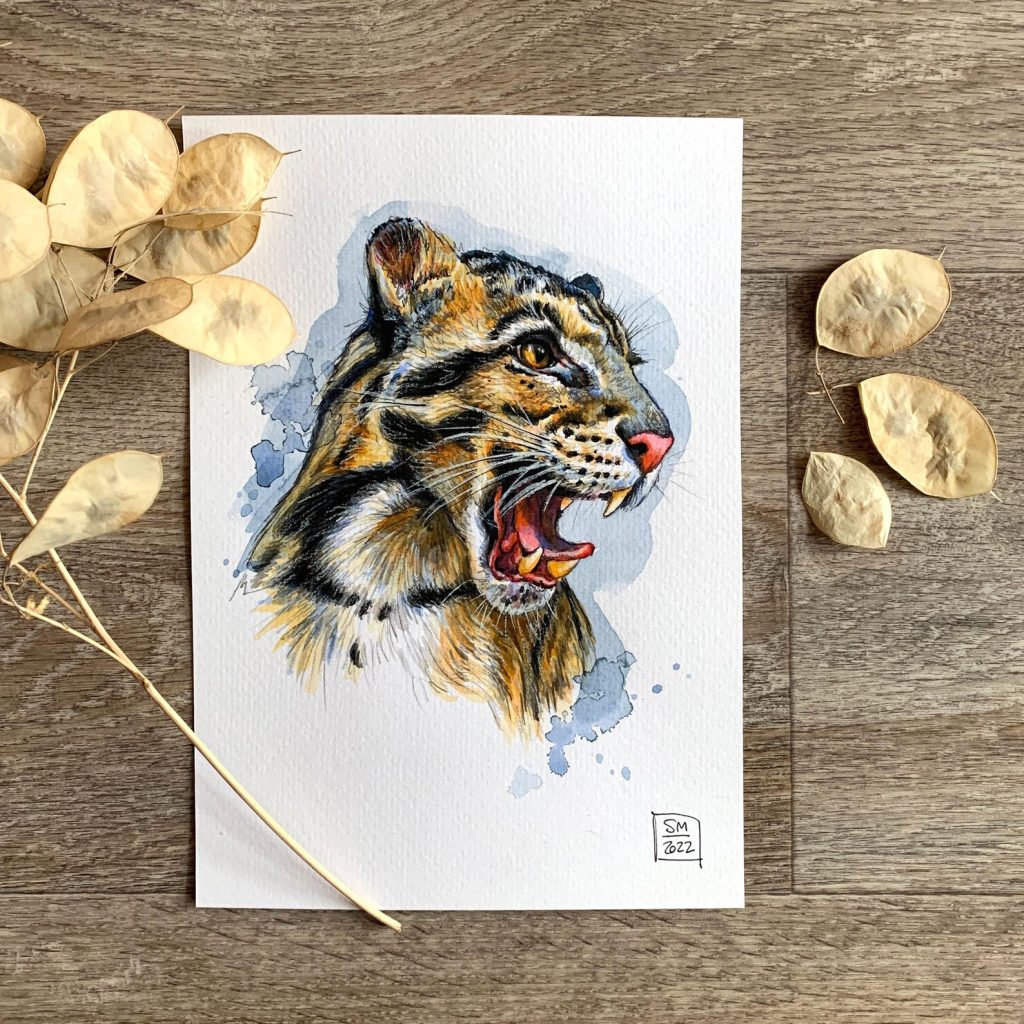
The forest dependent Sunda Clouded Leopard (Neofelis diardi) occurs on the islands of Borneo and Sumatra and is a sister species to the Mainland Clouded Leopard of Southeast Asia.
Habitat loss due to commercial logging and clearing of forests for oil palm plantations have directly contributed to a population decline of Clouded Leopards of more than 30% in only two decades (1993 - 2014).
Key Facts about Clouded Leopards
~ Longest upper canines of all cats ~
~ Cloud like coat markings ~
~ Tree climber and swimmer ~
Classification
The Sunda Clouded Leopard (Neofelis diardi) belongs to the genus Neofelis within the subfamily Pantherinae of the Felidae cat family. The full taxonomy or scientific classification of the Sunda Clouded Leopard species is:
Kingdom: Animalia (animals)
Phylum: Chordata (vertebrates)
Class: Mammalia (mammals)
Order: Carnivora (carnivores)
Suborder: Feliformia (cat-like)
Subfamily: Pantherinae (big cats)
Genus: Neofelis
Species: Neofelis diardi (Sunda Clouded Leopard)
Subspecies:
N.d. diardi
N.d. borneensis
Note: The scientific name for the Sunda Clouded Leopard species, Neofelis diardi, is also known as the binomial name, species name, latin name, biological name or zoological name. Some use the term 'botanical name' however that term is only applicable to the plant kingdom (botany) and not the animal kingdom (zoology).


Classification Chart
This Sunda Clouded Leopard classification chart shows where the species fits into the Felidae family and in particular the Neofelis genus.

Permission to use for personal or educational use.
Credit: www.WildCatFamily.com.

Subspecies
There are two subspecies of Sunda Clouded Leopards:
1. Sumatran Clouded Leopard - Neofelis diardi diardi (Sumatra and Batu islands)
2. Bornean Clouded Leopard - Neofelis diardi borneensis (Borneo)
The clouded leopards on the islands of Sumatra and Borneo were first described in 2006 as Sunda Clouded Leopards when genetic analysis showed sufficient differentiation from Mainland Clouded Leopards. In addition, the Sumatran and Bornean cats were distinct enough to be described as separate subspecies:
Coat pattern differences between the Mainland and Sunda Clouded Leopards:
Mainland: larger cloud markings with few inner spots
Sunda: smaller cloud markings with many inner spots
Reference: Kitchener et al. 2017. A revised taxonomy of the Felidae. The final report of the Cat Classification Task Force of the IUCN / SSC Cat Specialist Group.
Taxonomy Papers since 2017
Here is a list of taxonomy and related papers published on Clouded Leopards since the last Felidae revision in 2017. Click on the title bar to view the abstract and the link to the article.
Highlights
New whole genome assemblies are generated for the two species of clouded leopard
- Genome-wide diversity analyses confirm lower genetic diversity in the island species
Ancient divergence between clouded leopard species predates that of leopard and lion
Demographic analyses reveal distinct historical trajectories of Ne for each species
Abstract
Similar to other apex predator species, populations of mainland (Neofelis nebulosa) and Sunda (Neofelis diardi) clouded leopards are declining. Understanding their patterns of genetic variation can provide critical insights on past genetic erosion and a baseline for understanding their long-term conservation needs.
As a step toward this goal, we present draft genome assemblies for the two clouded leopard species to quantify their phylogenetic divergence, genome-wide diversity, and historical population trends.
We estimate that the two species diverged 5.1 Mya, much earlier than previous estimates of 1.41 Mya and 2.86 Mya, suggesting they separated when Sundaland was becoming increasingly isolated from mainland Southeast Asia.
The Sunda clouded leopard displays a distinct and reduced effective population size trajectory, consistent with a lower genome-wide heterozygosity and SNP density, relative to the mainland clouded leopard.
Our results provide new insights into the evolutionary history and genetic health of this unique lineage of felids.
Madeline G. Bursell, Rebecca B. Dikow, Henrique V. Figueiró, Olga Dudchenko, Joseph P. Flanagan, Erez Lieberman Aiden, Benoit Goossens, Senthilvel K.S.S. Nathan, Warren E. Johnson, Klaus-Peter Koepfli, Paul B. Frandsen
Whole genome analysis of clouded leopard species reveals an ancient divergence and distinct demographic histories
iScience, Volume 25, Issue 12,2022, https://doi.org/10.1016/j.isci.2022.105647

Books for Wild Cat Enthusiasts


Clouded Leopards: Modern Day Saber-Tooths by Animalogic
Research
Here is a list of papers published on Sunda Clouded Leopards. Click on the title bar to view the abstract and the link to the article.
In a broad sense, behavior is the visible actions carried out by living creatures to adapt to environmental conditions for survival. N. diardi borneensis is one of the endemic animals of Kalimantan and is considered the highest leader of the food chain in Kalimantan. The Bornean clouded leopard was once considered the same species as the clouded leopard (Neofelis nebulosa), but in 2006 it was classified as a different species. The Bornean clouded leopard, which is endangered, is very interesting as an object of observation. The presence of the Bornean clouded leopard in the South Kalimantan (Kalsel) BKSDA transit cage after evacuation is an opportunity to observe the behavior of this rare animal.
This study aims to determine the behavior of N. diardi borneensis while in the South Kalimantan BKSDA transit cage as scientific information that can be used as a reference for preservation and conservation programs. The method used is observation using the focal animal sampling method. Observations are divided into three periods: in the morning from 08.00 – 09.00, in the afternoon from 12.00 – 13.00, and the afternoon from 16.00 – 17.00. In each period, observations were made for 1 hour with recording intervals, namely every 5-minute interval, to calculate the duration/time of the behavior and then calculate the percentage.
The results obtained from observing the behavior of N. diardi borneensis for 14 days are the behavior shown by N. diardi borneensis during the transit drum, namely resting behavior with an average duration of 1883 minutes (75%), movement behavior with an average duration of 584 minutes (23%), and eating behavior with an average duration of 53 minutes (2%).
The Bornean clouded leopard has a unique special behavior: spending most of its time doing activities on tree branches (arboreal).
Alfian, Alfian & Nurliani, Anni & Sundari, Titik. (2024). PERILAKU MACAN DAHAN KALIMANTAN (Neofelis diardi borneensis) DI KANDANG TRANSIT BALAI KONSERVASI SUMBER DAYA ALAM KALIMANTAN SELATAN. BIOSCIENTIAE. 21. 57. 10.20527/b.v21i1.12102.
Sarawak is the largest state in the megadiverse country of Malaysia. Its rich biodiversity is threatened by land-use change and hunting, with mammalian carnivores particularly affected. Data on the ecology, occurrence and distribution of small carnivores are crucial to inform their effective conservation, but no large-scale assessments have previously been conducted in Sarawak.
Here we examine the status of the five species of felids in Sarawak based on data from camera-trap studies over 17 years (May 2003-February 2021) across 31 study areas, including protected areas of various sizes, production forests and forest matrix within oil palm plantations.
Felids were detected at 39% of 845 camera stations. The marbled cat Pardofelis marmorata and Sunda clouded leopard Neofelis diardi had higher probabilities of occurrence in protected than unprotected areas, and vice versa for the leopard cat Prionailurus bengalensis and bay cat Catopuma badia. The marbled and bay cats were mostly diurnal, and the leopard cat was predominantly nocturnal; activity patterns did not substantively differ between protected and unprotected sites. The probabilities of occurrence of marbled and bay cats increased with greater distance from roads. The leopard cat and flat-headed cat Prionailurus planiceps were more likely, and the clouded leopard less likely, to occur near rivers. Flat-headed cats preferred peat swamp forest, bay cats lowland forest, and marbled cats and clouded leopards occurred in both lowland and montane forest.
Felids may tolerate higher elevations to avoid anthropogenic disturbance; therefore, it is critical to preserve lowland and mid-elevation habitats that provide refugia from climate change and the destruction of lowland habitat.
Mohd-Azlan, J.; Kaicheen, S.S.; Hong, L.L.C.; Yi, M.C.K.; Maiwald, M.J.; Helmy, O.E.; Giordano, A.J.; Brodie, J.F.
Ecology, occurrence and distribution of wild felids in Sarawak, Malaysian Borneo
2023 Oryx (57): 252-261
Indonesia is home to the Javan Leopard (Panthera pardus melas) and the Sunda Clouded Leopard (Neofelis diardi), both of which are threatened by habitat loss, human-wildlife conflict issues and the illegal wildlife trade.
Leopards and clouded leopards are threatened by the illegal wildlife trade across their range, however, very little is known of the illegal trade in these two species in Indonesia, or of the efforts made to tackle this crime. Both the Javan Leopard and Sunda Clouded Leopard are protected species in Indonesia and both species are listed in Appendix I of the Convention on International Trade in Endangered Species of Wild Fauna and Flora (CITES), meaning commercial international trade is generally prohibited.
To better understand the trade, and efforts to end this trade, we collected records of seizures and prosecutions relating to Javan Leopards and Sunda Clouded Leopards in Indonesia for the period 2011-2019. Despite both species being protected by law, this study reveals the prevalence of extensive poaching, illegal domestic trade and international trafficking of both species.
A total of 41 seizure records were obtained from 2011 to 2019, which was estimated to amount to approximately 83 animals, which likely represents only a fraction of the total number of cases and therefore the risk may be substantially greater. Approximately half of the cases resulted in successful prosecution and of these, the highest sentence given was 2 years in jail and a fine of IDR50mil (~USD3300).
The majority of the penalties handed down for these crimes were far below the maximum potential penalties and are unlikely to be effective deterrents.
Gomez, L.; Shepherd, C.R.
The illegal exploitation of the Javan leopard (Panthera pardus melas) and Sunda clouded leopard (Neofelis diardi) in Indonesia
2021 Nature Conservation (43): 25-39
Most species of wild felids are threatened, but for many little is known about their status in the wild. For the cryptic and elusive Vulnerable Sunda clouded leopard Neofelis diardi, key metrics such as abundance and occupancy have been challenging to obtain.
We conducted an intensive survey for this species on the Indonesian island of Sumatra. We deployed camera traps across four study areas that varied in elevation and threats, for a total of 28,404 trap nights, resulting in 114 independent clouded leopard photographs, in which we identified 18 individuals.
Using a Bayesian spatially explicit capture-recapture analysis, we estimated clouded leopard density to be 0.8-2.4 individuals/100 km2. The highest predicted occurrence of people was at lower altitudes and closer to the forest edge, where we categorized more than two-thirds of people recorded by camera traps as bird poachers, 12.5% each as ungulate/tiger poachers and non-timber collectors, and < 2% as fishers.
Our findings provide important insights into the status of this little known species in Sumatra. We recommend that the large volume of camera-trap data from other Sumatran landscapes be used for an island-wide assessment of the clouded leopard population, to provide up-to-date and reliable information for guiding future conservation planning.
Haidir, I.; Maconald, D.W.; Linkie, M.
Sunda clouded leopard _Neofelis diardi_ densities and human activities in the humid evergreen rainforests of Sumatra
2021 Oryx (55): 189-196
Even with intensive sampling effort, data often remain sparse when estimating population density of elusive species such as the Sunda clouded leopard Neofelis diardi. An inadequate number of recaptures can make it difficult to account for heterogeneity in detection parameters.
We used data from large-scale camera-trapping surveys in three forest reserves in Sabah, Malaysian Borneo, to (1) examine whether a high-density camera-trap network increases the number of recaptures for females, which tend to be more difficult to detect, thus improving the accuracy of density estimates; (2) compare density estimates from models incorporating individual heterogeneity in detection parameters with estimates from the null model to evaluate its potential bias; and (3) investigate how the size of the camera-trap grid affects density and movement estimates.
We found that individual heterogeneity could not be incorporated in the single-site data analysis and only conservative null model estimates could be generated. However, aggregating data across study sites enabled us to account for individual heterogeneity and we estimated densities of 1.27-2.82 individuals/100 km2, 2-3 times higher than estimates from null models.
In light of these findings, it is possible that earlier studies underestimated population density. Similar densities found in well-managed forest and recently selectively logged forest suggest that Sunda clouded leopards are relatively resilient to forest disturbances. Our analysis also revealed that camera-trapping grids for Sunda clouded leopard density estimations should cover large areas (c. 250 km2), although smaller grids could be appropriate if density or detectability are higher.
Mohamed, A.; Sollmann, R.; Wong, S.T.; Niedballa, J.; Abrams, J.F.; Kissing, J.; Wilting, A.
Counting Sunda clouded leopards with confidence: incorporating individual heterogeneity in density estimates
2021 Oryx (55): 56-65
View more articles on Neofelis diardi on ResearchGate.
Consider joining the Friends of the Cat Specialist Group to access the full articles and receive their journal Cat News covering the latest wild cat research.
Conservation
The global conservation status for the Sunda Clouded Leopard is Vulnerable (VU) with a decreasing population primarily due to habitat loss.
The following organizations are dedicated to research and conservation of Mainland and Sunda Clouded Leopards:
Clouded Leopard Working Group - Conservation Clouded Leopards, Asiatic Golden Cats and Marbled Cats - Asia Smithsonian Institute - Clouded Leopard reproduction research - USAPlease support these organizations with their important work if you can. No matter the size of your contribution, every bit helps!
International Clouded Leopard Day is on August 4th annually - get involved if you love this wild cat!Past Projects:
- Clouded Leopard Programme - WildCRU's long term research - Asia
- Clouded Leopard Project - Clouded Leopard conservation and research - Asia

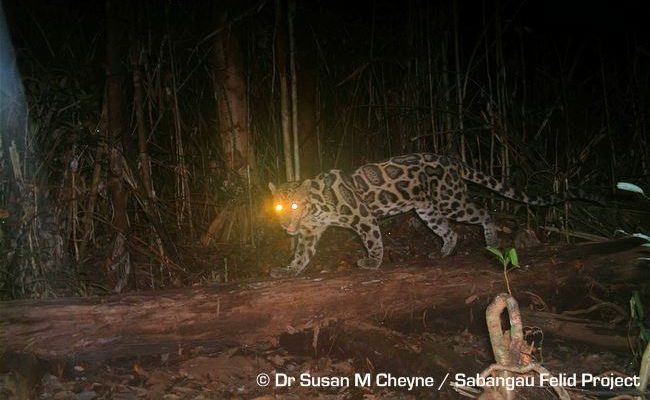
Facts and Information
The following organisations have well researched and authoritative information on Sunda Clouded Leopards:
- IUCN Cat Specialist Group - Detailed Information
- IUCN Red List - Status and Distribution Map
- Int. Soc. Endangered Cats - Species Overview
Note: Many websites will still reference both species under 'Clouded Leopard' as much of the information is very similar.
Trips to see Clouded Leopards
The following organizations offer tours to places in Asia where you are likely to see Clouded Leopards in their natural habitat. These companies offer small group experiences, support conservation projects, and indicate their trips are environmentally and ethically responsible:
- Cat Expeditions – Cats of Borneo Photo Tour
- Royle Safaris – Borneo Wildlife Tours
- Royle Safaris – Clouded Leopard Expedition
Always bear in mind that sightings of any particular animal in its natural environment are not guaranteed and the experience of guides will greatly enhance your success.

Royle Safaris
Borneo's Rare Mammals
Destination: Borneo
Next Tour: August
Duration: 15 nights
Focus: Rare Mammals including Borneo's Cats

Cat Expeditions
Cats of Borneo Photo Tour
Destination: Borneo
Next Tour: September
Duration: 14 nights
Focus: Sunda Clouded Leopard and other Bornean Cats