The 2025 Mammal Red List of South Africa, Lesotho, and Eswatini revision was coordinated by the Endangered Wildlife Trust (EWT) and the South African National Biodiversity Institute (SANBI). The assessments are based on the IUCN Red List criteria. The publication is referred to as a Regional Red List (as opposed to a National Red List) as it covers 3 countries - South Africa as well as Lesotho and Eswatini which are two small countries within South Africa's borders.
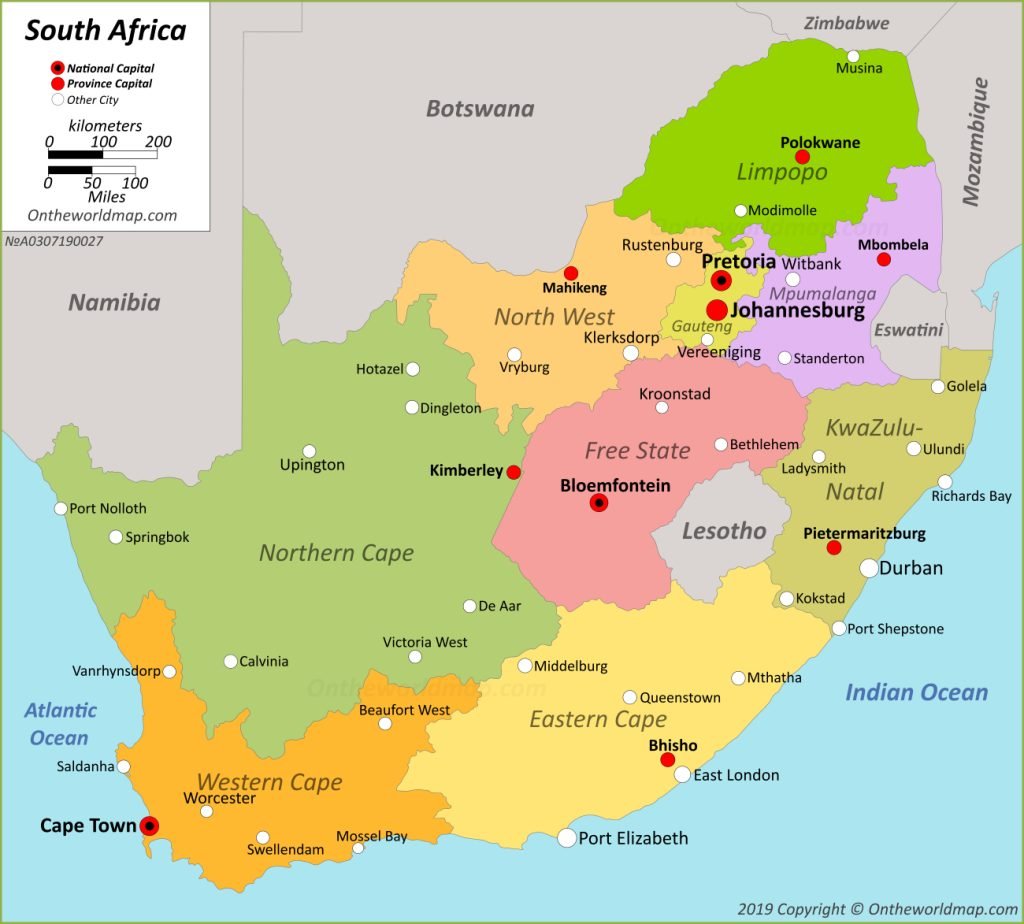
By Ontheworldmap.com
Seven wild cat species occur in South Africa - three big cats and four smaller cats. Here are summaries of the assessments of each felid species.
To receive a notification of new and updated blog posts - click on the red bell on the bottom right of your screen.
3 Big Cats ~ Assessment Summaries
Lion (Panthera leo)
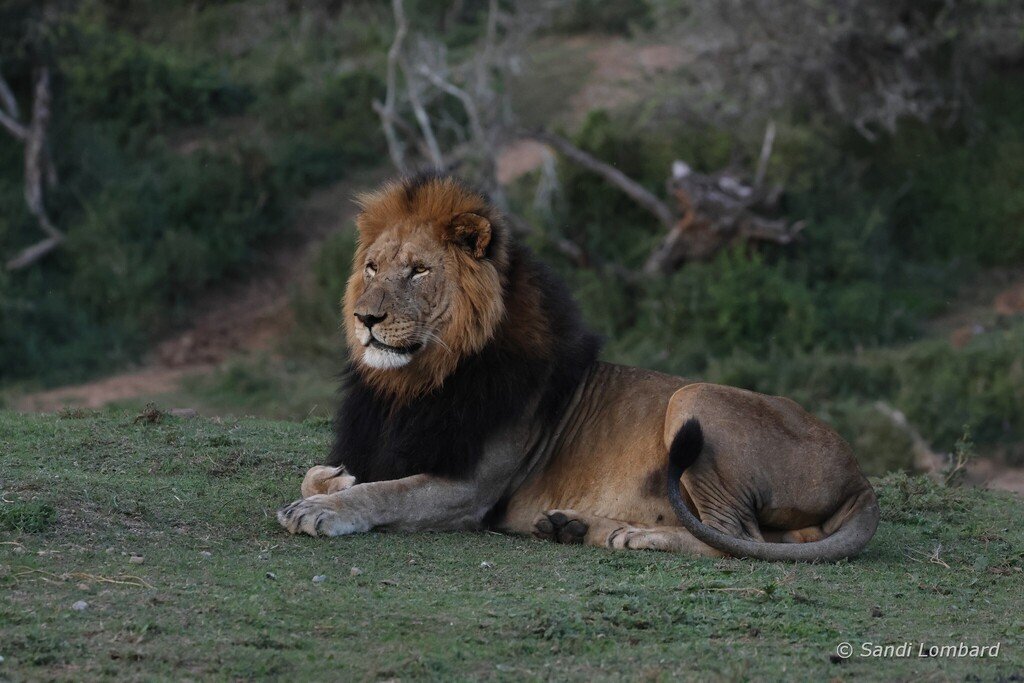
iNat Observation © sandilombard - (CC) BY-NC
Subspecies in South Africa: Southern Lion (Panthera leo ssp. melanochaita)
South Africa Status: Least Concern (LC)
South Africa Population Trend: Stable
- The Lion (Panthera leo) population in South Africa declined heavily in the 19th century but has been stable or increasing over the past 30 years, leading to its 2016 downlisting from Vulnerable to Least Concern.
- The 2016 assessment estimated 1,775 mature wild Lions, based on populations in large, protected areas and growing numbers in smaller fenced reserves that allow natural social and hunting behaviour.
- Updated data indicate continued growth in smaller reserves and private areas (including the Greater Kruger region), bringing the current estimate to about 2,007 mature wild Lions nationally.
- The species remains Least Concern because the two major wild populations in the Kgalagadi Transfrontier Park and the Great Limpopo Transfrontier Conservation Area have not declined over the last three generations, while smaller subpopulations continue to increase.
- Although no major threats currently drive declines, localized risks are emerging, including poaching (snares, poisoning), potential impacts from the Lion bone trade, and cultural use of Lion body parts, all of which require continued monitoring.
Reference: Miller SM, Ferreira S, Selier J, Williams V, Nicholson S & Minnie L. 2025. A conservation assessment of Panthera leo. In Patel T, Smith C, Roxburgh L, da Silva JM & Raimondo D, editors. The Red List of Mammals of South Africa, Eswatini and Lesotho. South African National Biodiversity Institute and Endangered Wildlife Trust, South Africa.
Leopard (Panthera pardus)

iNat Observation © 花蚀 - (CC) BY-NC
Subspecies in South Africa: African Leopard (Panthera pardus ssp. pardus)
South Africa Status: Vulnerable (VU)
South Africa Population Trend: Declining
- Wide distribution but limited protection: The Leopard (Panthera pardus) occurs across many habitats in South Africa, but 68% of suitable habitat lies outside protected areas, exposing populations to higher levels of human-related threats.
- Uncertain but relatively small population: Current estimates suggest 2,813–11,632 Leopards (1,688–6,979 mature individuals) in South Africa, though these figures are based on older habitat-suitability models and should be treated cautiously. Most subpopulations contain fewer than 1,000 mature individuals.
- Overall declining trend: Long-term monitoring shows an average decline of ~3% per year, equating to an estimated 27% population reduction over the past decade, although trends vary regionally with declines in some areas and stability or slight increases in others.
- Listed as Vulnerable: The species is assessed as Vulnerable (C1) due to its relatively small population and an ongoing projected decline of at least 10% over three generations (18–27 years).
- Key threats and conservation actions: Major threats include illegal harvesting for cultural regalia, bushmeat snaring, retaliatory killing linked to livestock conflict, and pressures on private land. Conservation responses include regulated hunting quotas, use of faux leopard skins for regalia, farmer education on livestock-protection methods, and expanded monitoring programs.
Reference: Mann GKH, Williams KS & da Silva JM. 2025. A conservation assessment of Panthera pardus. In Patel T, Smith C, Roxburgh L, da Silva JM & Raimondo D, editors. The Red List of Mammals of South Africa, Eswatini and Lesotho. South African National Biodiversity Institute and Endangered Wildlife Trust, South Africa.
Cheetah (Acinonyx jubatus)
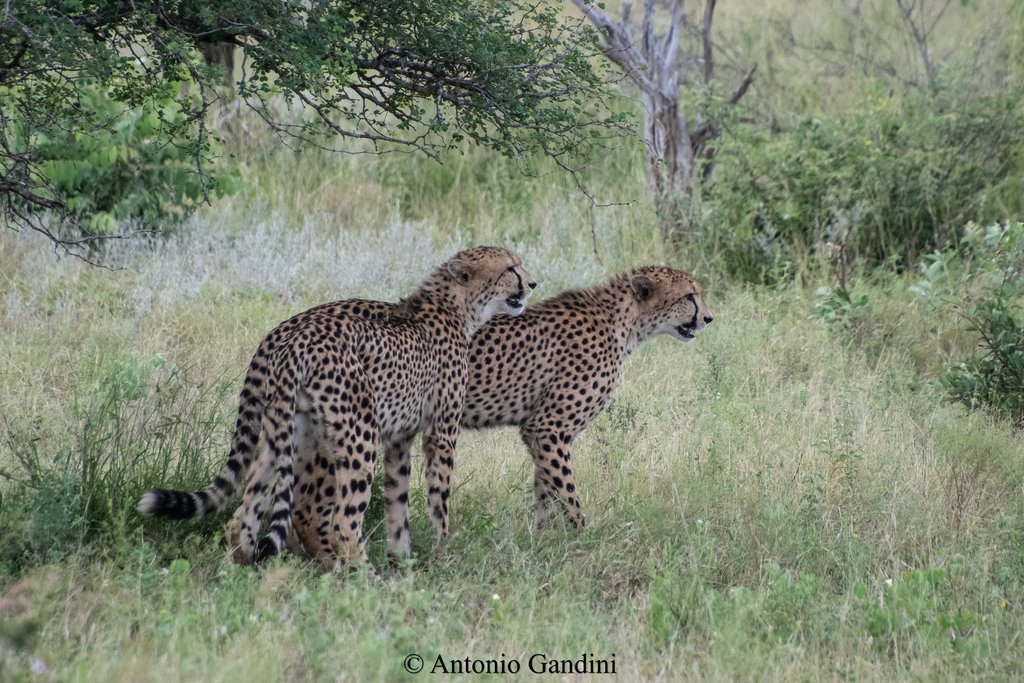
iNat Observation © Antonio Gandini - (CC) BY-NC
Subspecies in South Africa: Southern and Eastern African Leopard (Acinonyx jubatus ssp. jubatus)
South Africa Status: Vulnerable (VU)
South Africa Population Trend: Stable
- Range and population structure: Cheetah (Acinonyx jubatus) historically ranged widely across southern Africa but now occupies a reduced range in South Africa. The national population occurs in three groups: a free-roaming population, a managed metapopulation in fenced reserves, and a large captive population.
- Free-roaming population: Occurs over ~28,900 km² and is estimated at about 196 mature individuals, mainly in large protected areas such as Kruger National Park and Kgalagadi Transfrontier Park, with additional animals on surrounding private lands where human–wildlife conflict is a major threat.
- Managed metapopulation: Reintroduced Cheetahs occur in 67 fenced reserves (15,114 km²) supporting ~264 mature individuals. These populations require active management and translocations to maintain genetic diversity and demographic stability.
- Population size and estimates: The total wild population is estimated at ~656 individuals, lower than the 2016 estimate (1,166–1,742), largely due to improved survey methods and more accurate data, rather than a confirmed real decline.
- Threats and conservation status: Major threats include conflict-related persecution, snaring, road mortality, and fragmented management, while emerging concerns include captive–wild interactions and rewilding of captive animals. The species remains Vulnerable in South Africa due to a small, fragmented population (<1,000 mature individuals) and reliance on ongoing conservation management.
Reference: Marnewick K, Weise FJ, Nicholson S, Kerley GIH, Selier SAJ, Sievert O & Moodley Y. 2025. A conservation assessment of Acinonyx jubatus. In Patel T, Smith C, Roxburgh L, da Silva JM & Raimondo D, editors. The Red List of Mammals of South Africa, Eswatini and Lesotho. South African National Biodiversity Institute and Endangered Wildlife Trust, South Africa.
4 Small Cats ~ Assessment Summaries
Serval (Leptailurus serval)

iNat Observation © Niall Perrins - (CC) BY-NC
Subspecies in South Africa: Southern Serval (Leptailurus serval ssp. serval)
South Africa Status: Near Threatened (NT)
South Africa Population Trend: Declining
- Range recovery and expansion: Historically regionally extinct in parts of the Eastern Cape and most of the Western Cape by the 1980s, Serval (Leptailurus serval) populations have recovered through reintroductions in protected areas and natural range expansion, with new records in the Free State, eastern Northern Cape, and possibly North West and Lesotho.
- Habitat dependence and adaptability: Servals are wetland specialists but can persist in agricultural or industrial landscapes where wetlands and dense vegetation remain or are artificially created; density estimates in parts of KwaZulu-Natal range from about 6.2–7.7 individuals per 100 km².
- Major threat – wetland loss: Natural wetlands in South Africa declined by about 32.8% between 1990 and 2013/14, raising concerns about long-term habitat availability and suggesting a potential population decline linked to habitat loss.
- Population size and status: The area of occupancy is estimated at 18,789–209,738 km², with a mature population of roughly 4,509–13,654 individuals. Despite possible declines from habitat loss, persecution, and incidental snaring, the species is currently assessed as Near Threatened due to uncertainty about actual population trends and subpopulation structure.
- Conservation priorities: Recommended actions include protecting and restoring wetlands, maintaining vegetation buffers around water bodies, reducing persecution and snaring, monitoring hunting for cultural use, and improving monitoring and evaluation of reintroduction programs.
Power RJ & da Silva JM. 2025. A conservation assessment of Leptailurus serval. In Patel T, Smith C, Roxburgh L, da Silva JM & Raimondo D, editors. The Red List of Mammals of South Africa, Eswatini and Lesotho. South African National Biodiversity Institute and Endangered Wildlife Trust, South Africa.
Caracal (Caracal caracal)
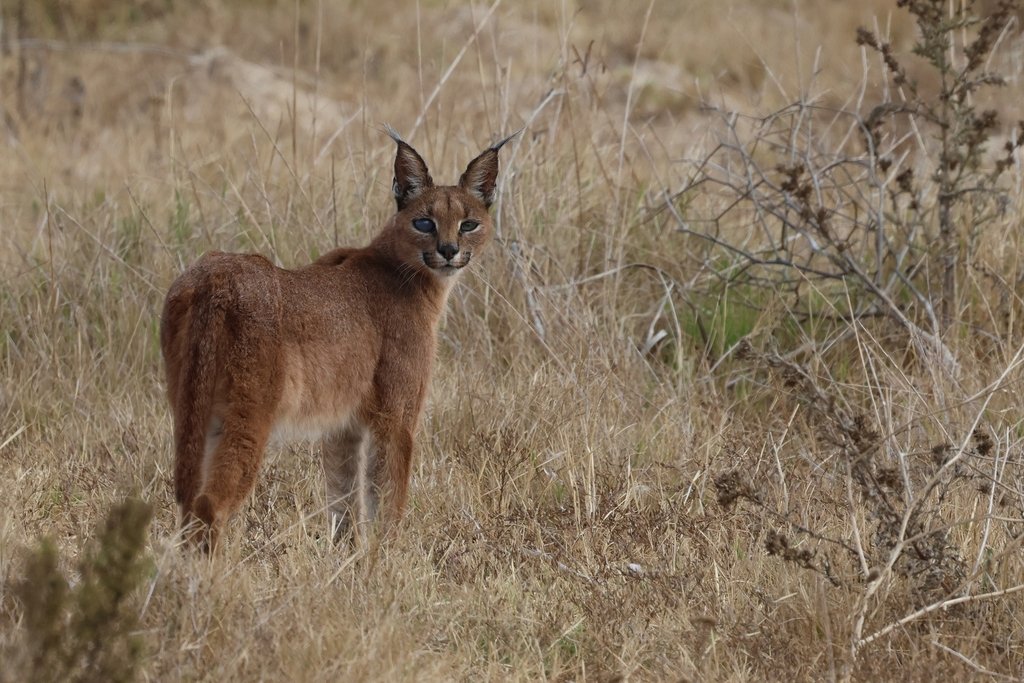
iNat Observation © murraychristian - (CC) BY-NC
Subspecies in South Africa: Southern and Eastern Caracal (Caracal caracal ssp. caracal)
South Africa Status: Least Concern (LC)
South Africa Population Trend: Unknown
- Widespread and adaptable: Caracals occur across most habitats in the region (except the driest parts of the Namib), tolerate human activity, and persist even in heavily farmed areas, with some regions possibly showing population increases.
- Current status: Due to their broad distribution and resilience, Caracals remain classified as Least Concern, with Namibia, Botswana, and South Africa forming a key global stronghold.
- Estimated population size: Although robust estimates are difficult due to limited data, the total Caracal population in the assessment region is likely over 20,000 individuals, based on wide distribution and extrapolated densities.
- Density estimates: Studies in protected areas suggest densities of about 0.23–0.47 Caracal/km² (e.g., Postberg Nature Reserve) and ~0.38/km² (Mountain Zebra National Park), with ~0.3/km² considered typical for high-density populations; overall densities may range 0.15–0.5/km² depending on habitat and persecution.
- Population trends and distribution: Caracals are common in South Africa and southern Namibia, with evidence of range expansion and increasing records in areas such as the North West Province, KwaZulu-Natal, and the Central Karoo, where many farmers reported rising numbers.
- Key threats and management needs: Intensive predator control, illegal poisoning, hunting, and live removals are concerns; continued monitoring, education, conflict-mitigation measures, and maintaining natural prey on farmlands are important to prevent future declines.
Reference: Drouilly M, Serieys LEK, Leighton GRM & da Silva JM. 2025. A conservation assessment of Caracal caracal. In Patel T, Smith C, Roxburgh L, da Silva JM & Raimondo D, editors. The Red List of Mammals of South Africa, Eswatini and Lesotho. South African National Biodiversity Institute and Endangered Wildlife Trust, South Africa.
African Wildcat (Felis lybica)

iNat Observation © Royle Safaris - (CC) BY-NC
Subspecies in South Africa: Southern African Wildcat (Felis lybica ssp. cafra)
South Africa Status: Least Concern (LC)
South Africa Population Trend: Stable
- Conservation status: The Southern African Wildcat (Felis silvestris lybica) is classified as Least Concern because it remains widely distributed and relatively common across the assessment region.
- Main threat – hybridisation: The greatest threat is hybridisation and genetic introgression with domestic cats, which occurs across the species’ range. Although studies in South Africa suggest lower hybridisation levels than previously expected, increasing human expansion around protected areas may intensify this threat.
- Domestic cat pressure: With an estimated ~600 million domestic cats worldwide, interbreeding with Wildcats is common and has already reduced the number of genetically pure Wildcat populations globally.
- Population data limitations: Total population numbers are unknown, partly because Wildcats are difficult to distinguish visually from domestic cats, making monitoring challenging. Localised studies (e.g., spoor surveys and camera trapping) suggest the species is fairly common in protected areas, but these do not provide reliable regional population estimates.
- Conservation actions and research needs: Recommended interventions include maintaining large protected areas (to reduce contact with domestic cats), spaying and neutering domestic cats near rural areas and reserves, and improved genetic research and monitoring to better detect hybridisation and assess the status of genetically pure populations.
Reference: Herbst M, Power RJ & da Silva JM. 2025. A conservation assessment of Felis lybica cafra. In Patel T, Smith C, Roxburgh L, da Silva JM & Raimondo D, editors. The Red List of Mammals of South Africa, Eswatini and Lesotho. South African National Biodiversity Institute and Endangered Wildlife Trust, South Africa.
Black-footed Cat (Felis nigripes)
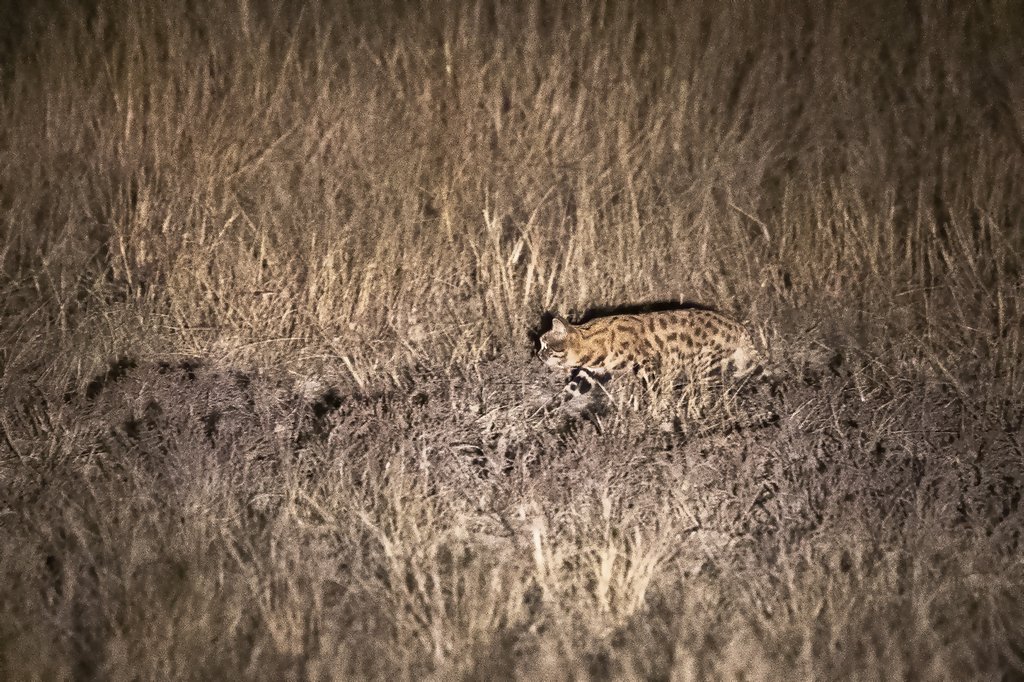
iNat Observation © Niall Perrins - (CC) BY-NC
Black-footed Cats are monotypic (no subspecies).
South Africa Status: Vulnerable (VU)
South Africa Population Trend: Declining
- The Black-footed Cat (Felis nigripes) is endemic to the arid regions of southern Africa and has the smallest distribution of any African felid. It is listed as Vulnerable by the International Union for Conservation of Nature and on Appendix I of the Convention on International Trade in Endangered Species of Wild Fauna and Flora.
- The global population is estimated at fewer than 10,000 mature individuals, with about two-thirds occurring in South Africa. The South African population is estimated at ~3,091 adults (1,545–4,637), occurring at low densities and in small subpopulations (<1,000 individuals each).
- Long-term monitoring at Benfontein Nature Reserve shows a major decline in density from 0.17 cats/km² (1998–1999) to 0.03 cats/km² (2024), suggesting >50% decline over three generations; recent spotlight surveys report the lowest sighting rates in 30 years.
- Major threats include predator persecution and illegal poisoning on livestock farms, indiscriminate predator control, domestic dogs, vehicles, habitat degradation (bush encroachment, desertification, prey loss), disease, illegal pet trade, and climate-driven habitat loss projected to reduce suitable habitat by 8–24% by 2040 and up to ~45% by 2070.
- The species also shows very low genetic diversity, increasing vulnerability to disease such as AA amyloidosis. Due to small population size, continuing declines, and multiple threats, the regional assessment supports maintaining the species as Vulnerable (C2a(i)), though improved population surveys are urgently needed.
Reference: Schroeder M, Drouilly M & Power RJ. 2025. A conservation assessment of Felis nigripes. In Patel T, Smith C, Roxburgh L, da Silva JM & Raimondo D, editors. The Red List of Mammals of South Africa, Eswatini and Lesotho. South African National Biodiversity Institute and Endangered Wildlife Trust, South Africa.
Leave a Reply